

Week One: The Gift of Grace
Grace always begins with God. In Week One, we learn to open our hands and let His gentle movement meet us — awakening the heart, quieting the striving, and making space for the gift He longs to give.
DEVOTIONAL: A JOURNEY INTO THE HEART
Brenda Lee Wheeler
7/15/20267 min read
If you are joining A Journey Into the Heart for the first time, welcome. This devotional series moves gently, week by week, inviting you to open your hands, soften your heart, and make space for God’s grace within you. Each reflection builds softly on the last, guiding you deeper into the interior work God is shaping in your life. To begin the journey as it was intended, I encourage you to start with the Introduction, where the foundation of “empty hands” and the posture of receiving grace is first explored.
As we walk through this tender topic, I want to invite you to honor your own boundaries. Sometimes, God invites us to step into difficult spaces, but sometimes He invites us to step into safe, professional care. If this conversation feels overwhelming rather than enlightening, I strongly encourage you to speak with a therapist or counselor. I am just a fellow Christian sharing my story and writings, not a licensed professional, and I want to ensure you are safe and supported.
What God Pours Into the Open Heart
Grace is the beginning of every Christian journey. It is the first movement of God toward the human soul — gentle, steady, and undeserved. Grace is not merely a doctrine or a theological term. Grace is God’s own life moving within us: His presence, His help, His healing, His strength, His love poured into the places where we are most in need.
Grace is God giving Himself. Grace is not earned; it is received. Grace is not achieved; it is welcomed. Grace is not distant; it is intimate.
Grace bends toward us with kindness. Grace does in us what we cannot do on our own. Grace stays with us in every step of the journey.
And grace always begins with God.
The Lifelong Movements of Grace
Christians throughout history have described grace as a lifelong movement of God’s love — a holy rhythm through which He draws us, saves us, forms us, and completes us. These movements are not abstract doctrines; they are the living ways God accompanies the soul from its first awakening to its final union with Him.
Understanding these movements helps us recognize how God is already at work within us, often quietly and slowly, shaping the heart from the inside out. These movements are referred to as The Four Pillars of Grace, and they form the theological foundation of the Christian life.
1. Prevenient Grace
The grace that goes before — the gentle stirring of God that awakens desire, softens resistance, and draws the heart toward Him long before we fully understand what is happening.
2. Justifying Grace
The grace that forgives, saves, and restores. It is God lifting the soul out of sin and placing it on solid ground.
3. Sanctifying Grace
The grace that transforms — the slow, interior work of the Holy Spirit shaping us into the likeness of Christ.
4. Glorifying Grace
The grace that completes — drawing the soul into eternal communion with God.
These movements form the arc of the Christian life — from first awakening to final union. This devotional series will offer only a gentle introduction to them, saving the deeper, richer exploration for a future retreat.
The Posture Grace Requires
Last week’s introduction taught us that grace requires empty hands — the posture of humility, openness, surrender, and spiritual poverty.
St. Augustine writes: “Let it [the heart] recognize empty hands, so that they may be filled by God.”
Empty hands represent the posture of receiving. The open heart represents the place where grace settles and transforms.
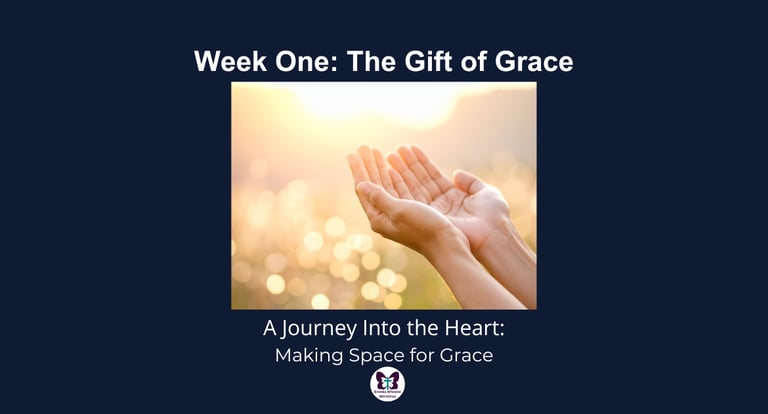
Week One invites you to begin by simply opening your hands — so your heart may open as well.
“By grace you have been saved — this is God’s gift, not your own doing.” [see Ephesians 2:8]
Grace is God’s gift. Your part is openness.
Beginning to Open Your Hands
Opening your hands is not a single moment. It is a slow, interior movement — a softening of the heart, a loosening of self‑reliance, a quiet willingness to let God be the One who acts first. Most of us do not begin with empty hands. We begin with hands full of fear, control, expectations, self-reliance, timelines, or the quiet belief that we must manage everything ourselves.
To open your hands is to let grace begin its work. It may feel small at first — a breath, a pause, a whispered prayer. It may feel like simply admitting, “Lord, I need You.” It may feel like letting go of one thing you’ve been gripping tightly.
Opening your hands is not about doing more. It is about releasing what keeps you from receiving.
What the Saints Teach Us About Opening the Heart
St. Augustine: Honest Poverty
Augustine reminds us that grace fills the heart that admits its emptiness. Opening your hands begins with truth — acknowledging your need.
St. Ignatius of Loyola: Interior Freedom
Ignatius teaches that clinging tightly to outcomes, fears, or self‑will keeps the hands closed. He invites us to pray for holy indifference — the freedom to desire only what leads us closer to God.
The Virgin Mary: The Courageous Yes
Mary shows us the most beautiful posture of open hands and open heart. Her fiat — “Let it be done to me according to your word” [see Luke 1:38] — is the purest expression of receptivity. She opened her hands to God even when she could not see the full path ahead.
Gentle Ways to Begin Opening Your Hands
1. Notice what you are holding.
Awareness loosens the grip of fear, pressure, or control.
2. Offer one small place to God.
You do not need to empty everything at once. Begin with one quiet surrender.
3. Practice a moment of stillness.
Stillness is the posture of open hands. A breath, a pause, a moment before God — these create space for grace.
4. Ask for Ignatian freedom.
Pray for the grace to desire only what leads you closer to God.
5. Let yourself be helped.
Opening your hands means letting God carry what you cannot.
6. Trust the slow pace.
Hands do not unclench instantly. Grace works gently, patiently, and without pressure.
“God gives where He finds empty hands.” — St. Augustine
Opening your hands is how you begin this journey. Grace is what God places into them. And the heart opens as the hands release.
Preparing Your Heart for Reflection
Before you begin the reflection questions, take a quiet moment to invite God into the space with you. St. Augustine often prayed, “Lord, let me know You, and know myself,” trusting that grace opens both the heart and the understanding. St. Ignatius taught that every time we enter prayer or reflection, we should first ask for the grace to see ourselves as God sees us — gently, truthfully, and with love.
Let this be your posture as you begin: a breath of stillness, a simple invitation, a quiet awareness of God’s presence.
If this way of praying is new for you, be patient with yourself. Like any spiritual practice, it becomes more natural with time. The more often you pause, invite God in, and listen, the easier it becomes to recognize His voice — whether through Scripture, memory, or a quiet movement of the heart.
These questions are not meant to be rushed. You may sit with one today, another tomorrow, and another later in the week. Let them accompany you slowly, giving grace room to settle and speak. There are no right or wrong answers — only what is honestly arising from your heart in this moment of prayer. And for some questions, you may not have a response right now, and that is perfectly okay. These reflections will gently build upon one another as you learn to empty your hands and open your heart week by week. A journal may help you hold your reflections gently, allowing you to return to them and notice how grace is unfolding over time.
Practice for the Week
Each day, pause for one quiet moment and open your hands before God — physically or interiorly — and whisper, “Lord, I receive Your grace.” Let this be your small act of surrender throughout the week, a simple way of keeping your heart open to what God desires to pour into it.
Reflection Questions for Week One
1. Where do I sense God inviting me to open my hands?
What part of my life feels tight, guarded, or self‑reliant?
Where do I notice resistance, fear, or a desire to stay in control?
2. What does St. Augustine’s teaching on “empty hands” reveal about my own need for God?
Note: If you would like a gentle reminder of what “empty hands” represent, you may return to last week’s Introduction, where this posture is explored more deeply.
Where do I need to admit my poverty so grace can fill me?
What might God be asking me to release so He can give me something better?
3. Where might God be inviting me to Ignatian interior freedom?
What attachments, fears, or expectations keep my hands closed?
What would it feel like to desire only what leads me closer to God?
4. How does Mary’s courageous yes inspire my own openness to grace?
Where is God inviting me to say, “Let it be done to me”?
What part of my life needs Mary’s trust, surrender, or quiet courage?
5. Which movement of grace feels most present in my life right now?
Prevenient, justifying, sanctifying, or glorifying — and why?
What signs, desires, or experiences point to this movement?
6. Where do I need to let grace be enough today?
What burden, expectation, or pressure could I release?
What would it look like to trust God’s sufficiency instead of my own strength?
7. What small signs of grace can I thank God for right now?
Even tiny movements of grace matter — name them.
Where have I seen God’s kindness, help, or presence in the past day or two?
Closing Prayer
Lord,
Teach me to open my hands
and loosen my grip on all I hold too tightly.
Let Your grace move freely within me —
healing what is wounded,
softening what is rigid,
and quieting the places where I strive in my own strength.
Empty what needs emptying,
and open what needs opening,
so my heart may become spacious enough to receive You.
Give me Augustine’s honesty,
Ignatius’s freedom,
and Mary’s courageous yes.
Shape me gently, faithfully,
and in Your perfect time.
Amen.
© 2026 Brenda Wheeler / Brenda Wheeler Ministries All rights reserved.
Scripture quotations are taken from public‑domain translations. Scripture references marked in brackets are paraphrased in the devotional voice of the author.
© 2020-2026 Provisions For The Journey / Brenda Wheeler Ministries / Brenda Lee Wheeler. All rights reserved.